Planting Spring Bulbs in New Jersey: Tips & Timing
Landscaping, Spring Flowering Bulbs, New Jersey Gardening
When to Plant Tulips, Daffodils & Spring-Flowering Bulbs in New Jersey
A colorful spring landscape in Ocean and Monmouth Counties does not begin in April – it starts months earlier, with thoughtful fall bulb planting and a clear plan for how you want your property to look when winter finally breaks.
Spring Color Starts in the Fall
For homeowners who want to plant tulips in New Jersey and enjoy carpets of daffodils, crocuses, and other spring bulbs, timing is everything. The bright flowers you admire in March, April, and May are the result of bulbs that were planted the previous fall, long before the first snow or frost. These spring-flowering bulbs need a period of cold dormancy in the soil in order to develop strong roots and reliable blooms the following season.
In coastal New Jersey – especially in Ocean County and Monmouth County – our relatively mild, maritime-influenced winters can be deceptive. Some years, cold weather arrives early and stays; other years, fall lingers with warm days well into November. That is why the experts at New Dimensions Landscaping Inc. focus less on the calendar and more on actual weather and soil conditions when determining when to plant bulbs in NJ for the best spring performance.
The Ideal Planting Window for Spring Bulbs in Coastal New Jersey
Most spring-flowering bulbs – including tulips, daffodils, alliums, crocuses, and hyacinths – are planted in the fall, typically from mid-October through late November in our region. However, the most reliable guide for spring bulbs in New Jersey is soil temperature, not a specific date on the calendar. Bulbs establish best when soil temperatures have cooled to roughly the low 50s Fahrenheit and nighttime air temperatures consistently dip into the 40s or upper 30s without returning to summer-like warmth.
In Ocean and Monmouth Counties, this sweet spot typically arrives in late October and continues into November. Coastal areas may stay slightly warmer longer than inland locations, so properties closer to the bay or ocean may trend a week or two behind those farther inland. During this period, the soil is still workable, yet cool enough to signal bulbs to develop roots rather than sprout foliage immediately. This balance is crucial for strong flowering the following spring and is the foundation of successful fall bulb planting in Ocean County, NJ and nearby communities.
Why Planting Too Early Can Be a Problem
It can be tempting to get a head start on fall chores and plant tulips or daffodils as soon as bulbs appear in local garden centers. However, in coastal New Jersey, planting bulbs too early – while soil is still warm – can encourage premature top growth. Instead of focusing on root development, bulbs may send up foliage in the fall, only to have it damaged by early frosts. This stress can weaken the bulb, reduce spring flowering, and shorten the bulb’s long-term performance in your landscape beds and borders.
Early planting can also expose bulbs to extended periods of soil moisture and warmth, increasing the risk of rot, especially in heavier or poorly drained soils. As a local landscape company, we frequently adjust planting schedules year to year based on actual fall conditions, ensuring that your investment in spring flowering bulbs in NJ is protected from avoidable losses caused by premature planting.
Why Planting Too Late Can Also Cause Issues
On the other end of the spectrum, waiting too long to plant bulbs can be just as problematic. Once the ground begins to freeze or repeated hard frosts arrive, bulbs have less time to establish roots before winter sets in fully. Without adequate root growth, bulbs may heave out of the soil during freeze–thaw cycles or struggle to take up enough moisture to fuel spring flowering. Late-planted bulbs often produce smaller, weaker blooms and may fail to return reliably in future years.
In Ocean and Monmouth Counties, we generally avoid planting bulbs after the soil has frozen hard, but there can still be opportunities in early December if the ground is workable and temperatures remain moderate. In those cases, we may adjust planting depth slightly or add a protective layer of mulch to help insulate bulbs and encourage root development. The key is responding to the season in real time rather than relying on a rigid, one-size-fits-all date range found on national gardening websites.
Understanding the Different Types of Spring-Flowering Bulbs
One of the major advantages of professional tulip planting in Monmouth County, NJ and surrounding areas is the ability to combine multiple types of bulbs for a long, layered season of color. Each type of bulb has its own bloom period, height, and character. When thoughtfully combined, they create a progression of flowers from late winter through late spring, rather than a single, brief burst of color.
Tulips: Bold Color and Design Flexibility
Tulips are often the stars of spring displays, offering vivid colors, clean lines, and a modern feel that works beautifully with both traditional and contemporary homes in coastal New Jersey. Depending on the variety, tulips can bloom from early April into May, with early, midseason, and late groups available. This allows us to stage tulip color so that different beds peak at different times or to create a wave of color that moves across the property as the season progresses.
In our region, tulips are often treated as annuals – especially in high-visibility front yards – because coastal conditions, soil, and deer pressure can limit their long-term repeat performance. That said, with the right varieties and conditions, some tulips can return for several years. As part of our design process, we discuss whether you prefer a high-impact, one-season display or a more naturalized, long-term approach to spring bulbs in New Jersey.
Daffodils: Reliable, Naturalizing Favorites
Daffodils (also called narcissus) are among the most dependable spring-flowering bulbs for Ocean and Monmouth County landscapes. They offer cheerful yellow, white, and bi-color blooms and tend to return year after year, often multiplying into larger clumps over time. Daffodils range from early to late spring bloomers, making them ideal for extending color throughout the season when combined with tulips and other bulbs.
Because daffodils are generally less attractive to deer and rodents, they are a smart backbone for bulb plantings in areas with heavy wildlife pressure. Strategically mixing daffodils with tulips and other more vulnerable bulbs can help reduce browsing and provide a more reliable display over time, especially in neighborhoods where deer are a regular presence.
Alliums: Architectural Accents for Late Spring
Ornamental alliums are members of the onion family, known for their distinctive globe-shaped flower heads perched on tall, slender stems. They typically bloom in late spring, often after tulips and daffodils have begun to fade, providing a valuable bridge between early bulbs and the first flush of summer perennials. Colors range from deep purple to white and soft lavender, and their sculptural forms add a sophisticated layer to modern landscape designs in coastal New Jersey communities.
Alliums are also relatively unappealing to deer and rodents, making them a strong choice for exposed areas. They pair beautifully with ornamental grasses, low-growing perennials, and boxwood or other evergreen structure, delivering a refined look that feels at home in both formal and informal settings.
Crocuses: The First Signs of Spring
Crocuses are among the earliest bulbs to bloom, often appearing while snow is still melting. They provide low, colorful carpets in shades of purple, white, yellow, and striped combinations. In Ocean and Monmouth Counties, crocuses can bloom in late February into March during milder years, making them an excellent choice for homeowners who crave the first signs of life after winter. They work especially well along walkways, at the edges of beds, and in lawns where they can naturalize between turf grasses.
Hyacinths: Fragrance and Color at Eye Level
Hyacinths are prized for their intense fragrance and dense spikes of flowers in a wide range of colors, from soft pastels to bold jewel tones. Blooming in mid-spring, they are perfect near entryways, patios, and seating areas where their scent can be fully appreciated. In a professional design, hyacinths are often grouped in clusters for maximum impact and combined with lower-growing groundcovers or cool-season annuals to hide fading foliage later in the spring.
Professional Landscape-Design Techniques for Using Bulbs Effectively
Planting a few bulbs here and there can yield scattered flowers, but to achieve the kind of cohesive, high-impact display that stands out in Ocean and Monmouth County neighborhoods, a more intentional design approach is required. At New Dimensions Landscaping Inc., we treat bulb planting as an integral part of your overall landscape plan, not an afterthought. Several key strategies help us create professional results for spring flowering bulbs in NJ.
Planting in Groups, Drifts, and Masses
Bulbs are most effective when planted in substantial numbers. Rather than a single row of tulips along a foundation, we often design broad swaths or drifts of color that echo the natural flow of the landscape. Grouping bulbs in clusters of 10, 25, or even 50 or more creates a visually powerful impact that reads clearly from the street or from interior windows. This approach is especially effective for tulip planting in Monmouth County, NJ where many homes have generous front yards and long sightlines from the road.
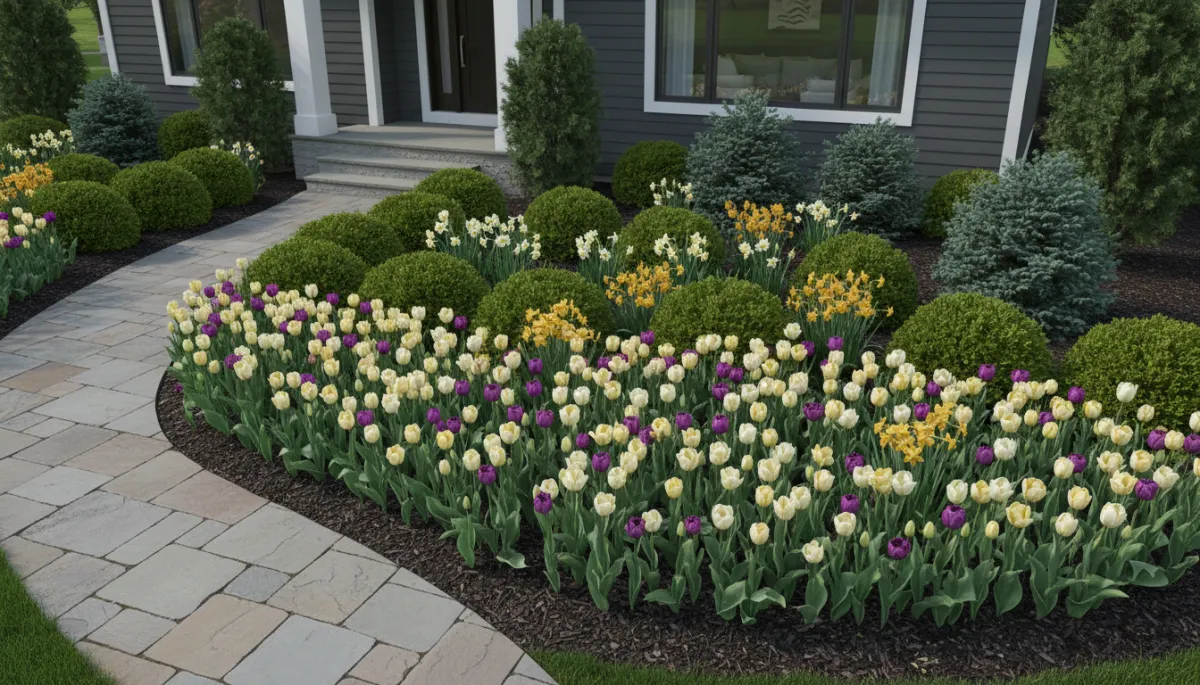
Sweeping drifts of bulbs deliver stronger curb appeal than scattered, individual plantings.
Layering Bulbs with Shrubs and Perennials
Bulbs shine brightest when they are part of a layered planting scheme. Underplanting deciduous shrubs and small ornamental trees with bulbs allows the bulbs to take advantage of early spring sunlight before foliage fills in overhead. As the season progresses, emerging perennials and shrub leaves help conceal the fading bulb foliage, keeping beds attractive throughout the year. This technique is especially useful along foundations, property lines, and in mixed borders where we want continuous interest from late winter through fall.
Highlighting Walkways, Drives, and Entryways
Spring-flowering bulbs are a natural fit along front walks, driveways, and entry paths where they create a welcoming experience for guests and homeowners alike. Repeating color themes along these routes helps guide the eye and reinforces the architecture of the home. For example, a neutral exterior can be warmed with golden daffodils and soft blue hyacinths, while a home with blue or gray siding might be paired with white tulips and pale pink accents for a refined, coastal-inspired palette. These details are part of what distinguishes a professionally designed spring bulbs New Jersey display from a simple DIY planting.
Extending Bloom Time with Varied Plant Choices
While some sources suggest staggering planting dates to extend bloom time, the more reliable strategy in our climate is to select a range of early, mid, and late-season bulb varieties. Because bulbs respond primarily to temperature and day length rather than planting date, mixing crocuses, early daffodils, midseason tulips, late tulips, and alliums creates a natural progression of color from late winter through late spring. This approach ensures that, regardless of seasonal fluctuations, there is always something in bloom during the spring months in your Ocean or Monmouth County landscape.
Deer and Wildlife Considerations for Spring Bulb Plantings
Many neighborhoods in coastal New Jersey experience regular deer activity, and homeowners quickly learn that not all plants are equally safe from browsing. When planning to plant tulips in New Jersey, it is important to recognize that tulips are among the bulbs deer find most appealing. In areas with heavy deer pressure, unprotected tulips may be eaten to the ground before they ever bloom, especially if no deterrent measures are in place.
Daffodils, alliums, and many hyacinths, on the other hand, are generally less appealing to deer and rodents due to their taste and chemical makeup. While no plant is completely deer-proof, these bulbs are often left alone even in neighborhoods where tulips and some perennials are frequently browsed. As part of our design process, we evaluate deer pressure on your specific property and may recommend:
Using daffodils and alliums as a protective “buffer” around small groups of tulips
Placing tulips closer to the home, within fenced or more protected areas
Incorporating physical barriers or repellents when necessary to protect high-value displays
By combining more deer-resistant bulbs with strategic placement and, where appropriate, supplemental protection, we can create spring bulb plantings that are both beautiful and realistic for local conditions in Ocean and Monmouth Counties.
Site Considerations: Sunlight, Soil, Drainage, and Planting Depth
Even when you choose the right planting window, success with spring flowering bulbs in NJ depends on matching bulbs to appropriate site conditions. Our coastal climate, sandy soils in some neighborhoods, and heavier soils in others all influence how bulbs perform. When we plan bulb installations, we evaluate several key factors.
Sunlight Requirements
Most spring-flowering bulbs prefer full sun to light shade, meaning they should receive at least 4–6 hours of direct sunlight per day during their growing season. Because bulbs emerge before many trees leaf out, they can often thrive beneath deciduous trees that would be too shady for summer annuals or perennials. We carefully assess how light changes through the seasons on your property to identify ideal locations for long-term bulb plantings, especially in established landscapes with mature trees and shrubs.
Drainage and Soil Conditions
Bulbs are highly sensitive to excess moisture. They resent “wet feet” and can quickly rot in soil that stays saturated, especially during winter and early spring. In Ocean and Monmouth Counties, low-lying areas, compacted soils, or locations where downspouts discharge can be problematic for bulbs. As a rule, we avoid planting bulbs in consistently wet areas and instead choose well-drained beds, slopes, or raised planting areas where water does not linger.
For properties with heavy or compacted soil, we may incorporate organic matter to improve structure and drainage or recommend alternative locations better suited to bulbs. In sandy coastal soils, we pay attention to moisture retention and may adjust planting depth to ensure bulbs are adequately protected from drying out during winter winds and early spring thaws.
Proper Planting Depth and Spacing
Planting depth is another important detail that affects bulb performance. As a general guideline, bulbs are planted at a depth of approximately two to three times their height, measured from the base of the bulb to the soil surface. Tulips and daffodils are typically planted 6 to 8 inches deep, while smaller bulbs like crocuses may be planted 3 to 4 inches deep. Proper depth helps protect bulbs from temperature extremes, drying winds, and animal disturbance while encouraging strong root development in the fall.
Spacing depends on the desired effect. For a naturalized look, bulbs may be spaced more irregularly and farther apart. For dense, high-impact beds, bulbs are planted closer together, often with a staggered pattern so that foliage and flowers fill in evenly. Our crews are trained to follow specific spacing plans to ensure that the final display matches the intended design, whether subtle and natural or bold and formal.
Irrigation and Moisture Management
While bulbs need moisture to establish roots after planting, they do not require heavy irrigation. In fact, overwatering can contribute to rot, especially in the cool, damp conditions of late fall. In Ocean and Monmouth Counties, natural rainfall is often sufficient once bulbs are planted, though we may provide an initial watering to settle soil around newly installed bulbs. In beds with automatic irrigation, we may adjust fall schedules or head locations to avoid oversaturating bulb areas during dormancy. Proper moisture management is an important part of successful fall bulb planting in Ocean County, NJ and similar coastal environments.
Design Your Spring Landscape in the Fall
Bulbs are most effective when they are part of a comprehensive design strategy. At New Dimensions Landscaping Inc., we encourage homeowners in Ocean and Monmouth Counties to think of fall as the ideal time to plan their spring landscape. This is when we can evaluate existing plantings, discuss upcoming renovations, and determine where spring bulbs in New Jersey will have the greatest impact on curb appeal and everyday enjoyment.
For homeowners planning larger landscape projects – such as new walkways, patios, retaining walls, or planting beds – fall bulb planting can be coordinated with construction schedules so that new hardscapes and plantings emerge in spring already framed by color. For established landscapes, we can integrate bulbs into existing beds, refresh tired areas with seasonal displays, or create new focal points that align with your home’s architecture and your personal style. Designing the spring display in advance allows us to map out bloom sequences, color themes, and viewing angles, ensuring that every part of your property is considered.
Combining Bulbs with Pansies and Other Cool-Season Annuals
One of the most effective ways to create a truly polished spring display is to combine bulbs with cool-season annuals such as pansies, violas, and ornamental cabbages. These plants tolerate chilly temperatures and can be installed in fall or early spring to provide color before and after bulbs bloom. For example, we may plant tulips and daffodils in the back of a bed with a foreground of pansies, so that as bulbs emerge through the pansies, the entire bed appears full and finished rather than sparse or patchy.
This layered approach is particularly effective for high-visibility areas such as front entries, foundation beds, and community common spaces. It also allows us to transition seamlessly into summer plantings once bulb foliage begins to decline. Pansies and other cool-season annuals can be replaced with warm-season flowers while bulb foliage is left to mature and recharge the bulbs for the following year. As a full-service landscape company, we can coordinate these seasonal changes so that your property looks professionally maintained and colorful from early spring through late fall without gaps in interest.
Frequently Asked Questions About Spring Bulbs in New Jersey
When is the best time to plant tulips and other bulbs in Ocean and Monmouth Counties?
The ideal time to plant bulbs in NJ coastal areas is typically from late October through November, when soil temperatures have cooled but the ground is not yet frozen. We watch for nighttime temperatures in the 40s and soil temperatures in the low 50s. Planting during this window allows bulbs to develop strong roots before winter without encouraging premature foliage growth.
Are any spring-flowering bulbs truly deer-proof?
No plant is completely deer-proof, but some bulbs are much less appealing than others. Daffodils, alliums, and many hyacinths are generally avoided by deer and rodents, making them good choices for properties with regular wildlife activity. Tulips, on the other hand, are highly attractive to deer. As part of our design process, we consider local deer pressure and may combine more resistant bulbs with strategic placement and protective measures to help preserve your display.
Can I plant different types of bulbs together in the same bed?
Yes. In fact, combining tulips, daffodils, alliums, crocuses, and hyacinths in the same bed is one of the best ways to create a long-lasting, layered display. We often design beds with early, mid, and late-season bulbs planted at appropriate depths so that each group blooms in sequence. Complementary colors and varying heights add depth and interest, ensuring that the bed remains attractive throughout the spring season.
Do I need to dig up my bulbs every year?
Most daffodils, alliums, and many smaller bulbs can remain in the ground year after year and may even multiply over time. Tulips, however, often perform best when treated as annuals in our region, especially in high-visibility locations where consistent, full displays are desired. As part of your maintenance plan, we can advise which bulbs are likely to return reliably and where it makes sense to replant annually for the best appearance.
Can spring bulbs be added to an existing landscape without major changes?
Absolutely. One of the advantages of professional spring bulbs New Jersey installations is that they can be woven into existing beds, borders, and foundation plantings with minimal disruption. We evaluate your current layout, identify open spaces and underused areas, and design bulb groupings that enhance what you already have. This makes fall bulb planting a cost-effective way to upgrade the look of your property without a full landscape renovation.
Partner with New Dimensions Landscaping for Professional Fall Bulb Planting
Planning and installing spring flowering bulbs in NJ is both an art and a science. It requires an understanding of local climate, soil conditions, and wildlife behavior, as well as a designer’s eye for color, texture, and seasonal flow. At New Dimensions Landscaping Inc., we bring years of experience working specifically in Ocean and Monmouth Counties to every project, from small front-yard enhancements to complete property renovations.
Whether you are looking to plant tulips in New Jersey for a bold, contemporary statement, create naturalized drifts of daffodils along a woodland edge, or design a coordinated sequence of bulbs, pansies, and perennials for a high-profile front entry, our team can handle every detail. We manage timing, sourcing of quality bulbs, professional installation, and follow-up seasonal color changes so that you can simply enjoy the results when spring arrives.
If you live in Ocean or Monmouth County and are ready to transform your property with professionally designed spring bulb displays, contact New Dimensions Landscaping Inc. to schedule a consultation. We will walk your site, discuss your goals and style preferences, and develop a customized plan for fall bulb planting, seasonal annuals, and overall landscape design. Start planning now, and when spring returns to coastal New Jersey, your home will be ready with a landscape that reflects the care and quality you expect.
